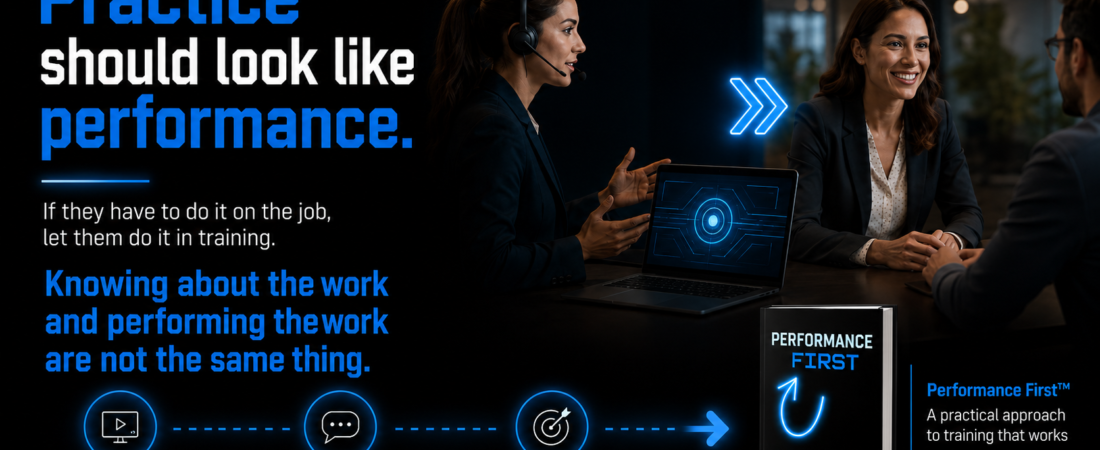
If the job requires people to do something, training should give them an opportunity to do it.
That sounds obvious.
And yet it is surprisingly easy to design training where the learner spends most of the time doing something completely different from the performance we ultimately expect.
If employees need to make judgment calls, reading a policy isn’t practice.
If they need to navigate a system, watching someone else demonstrate it isn’t practice.
If they need to handle a difficult conversation, selecting the correct response on a knowledge check isn’t the same as having the conversation.
If they need to diagnose a problem, remembering the steps doesn’t necessarily mean they can recognize when and how to use them.
Knowledge matters. But knowing about the work and performing the work are not the same thing.
Once we know what employees need to do differently, one of the most useful questions we can ask is:
How can we let them practice that performance before the consequences are real?
The practice doesn’t always have to reproduce the workplace perfectly. Sometimes that isn’t practical or even possible.
But it should require enough of the actual thinking, deciding, communicating or doing to matter. Successful practice tells us something meaningful about whether the learner is becoming ready to perform.
That is one of the principles behind Performance First™: A practical approach to training that works.